Sunday, 19 April 2015
Leadership Styles
Have just finished the test for leadership styles at:
http://www.kent.ac.uk/careers/sk/leadership.htm
and got the following results:
Your score is:
Authoritarian 30
Procedural 27
Transformational 36
Participative 40
Laissez Faire 39
Interesting that I appear pretty even weighted across many of the leadership styles. I wonder what that means for my leadership development?
Some information about each of the styles is found at the above website, so I'm going to try to uncover a bit more.

Leadership Styles
Looking at leadership theories for our Postgraduate Certificate in Applied Practice for Mind Lab. There are a large number of leadership theories out there and during this study we have looked foremostly at Transactional Leadership and Transformational Leadership. An interesting journey so far, I'm still developing my opinion of what type of leadership would be the 'most effective'. I can identify with the fact that some have believed that leadership is dependent on the situation (Situational Leadership) as I've seen a number of different working environments and have doubts about the way that leadership could work in each. However, I also know what most people are driven by similar things and therefore, once a leader is aware of this, transformational leadership could theoretically be easier to employ.
I came across this video, sharing an overview of 10 of the main leadership styles and had a look at this before I go looking further for what I consider to be the best informational clips on Transformational Leadership, which is the area I'm most interested in.
Praise - Intelligence vs Effort
This video is a great example of how subtle differences can hugely impact the effort and understandings our students have around learning. For many years now, emphasis has been placed on encouraging teachers to espouse the effort of the student as opposed to their intelligence - heightening the likelihood that students will view their achievement as something that is not fixed and related to (for example) IQ, but rather, something capable of being developed. This video explains why.
Friday, 10 April 2015
Google Summit South
Wow, where to start!?
Google Summit South was held in Christchurch, where five of us GisInt teachers attended workshops at Burnside High over the course of April 8th and 9th, 2015. I've wanted to attend Google Summit for a few years now but had no idea of the impact it would have on my pedagogy, future direction and personal viewpoints.
While I wasn't overwhelmed with the number of suggestions of new tools or apps etc at the conference, this wasn't because there weren't a large number there - more due to the fact that in our past year, as a team, the e-learning team have explored so many great tools already. With the advent of Google Apps for Education, the focus has become less on teching and more on teaching. This means that what we encountered at Google Summit was more a great meeting of the minds and exploration of tried and tested practices, policies and pedagogies that are vital in our current state of education. Like Chris Betcher said, we are not there to teach the nouns - it's not important that our students know how to use Google Slides, or PowerPoint, or iMovie... but rather that they are able to ascertain the best tool to enact the verbs - persuading, presenting, explaining etc. Powerful shifts in education and as such, powerful and deep learning planned for our students. Technology use can make the learning superficial..... technology integration means using technology as just tools for learning. Nevermind the 'ICT focus' or 'e-learning' going on in the room - it's just learning.
And upon my return from Google Summit South I feel like my learning has been profound. I've gathered a few new tools.... but more importantly, I'm looking at how to integrate them seamlessly into our learning environments so they are inconspicuous but powerfully supportive of what we do as educators... moving our students towards environments where there is ubiquity, agency and connectedness in order for students to not just become 'life-long learners' but to become what the world needs - innovators, designers and creators.
Thank you Google Summit South!
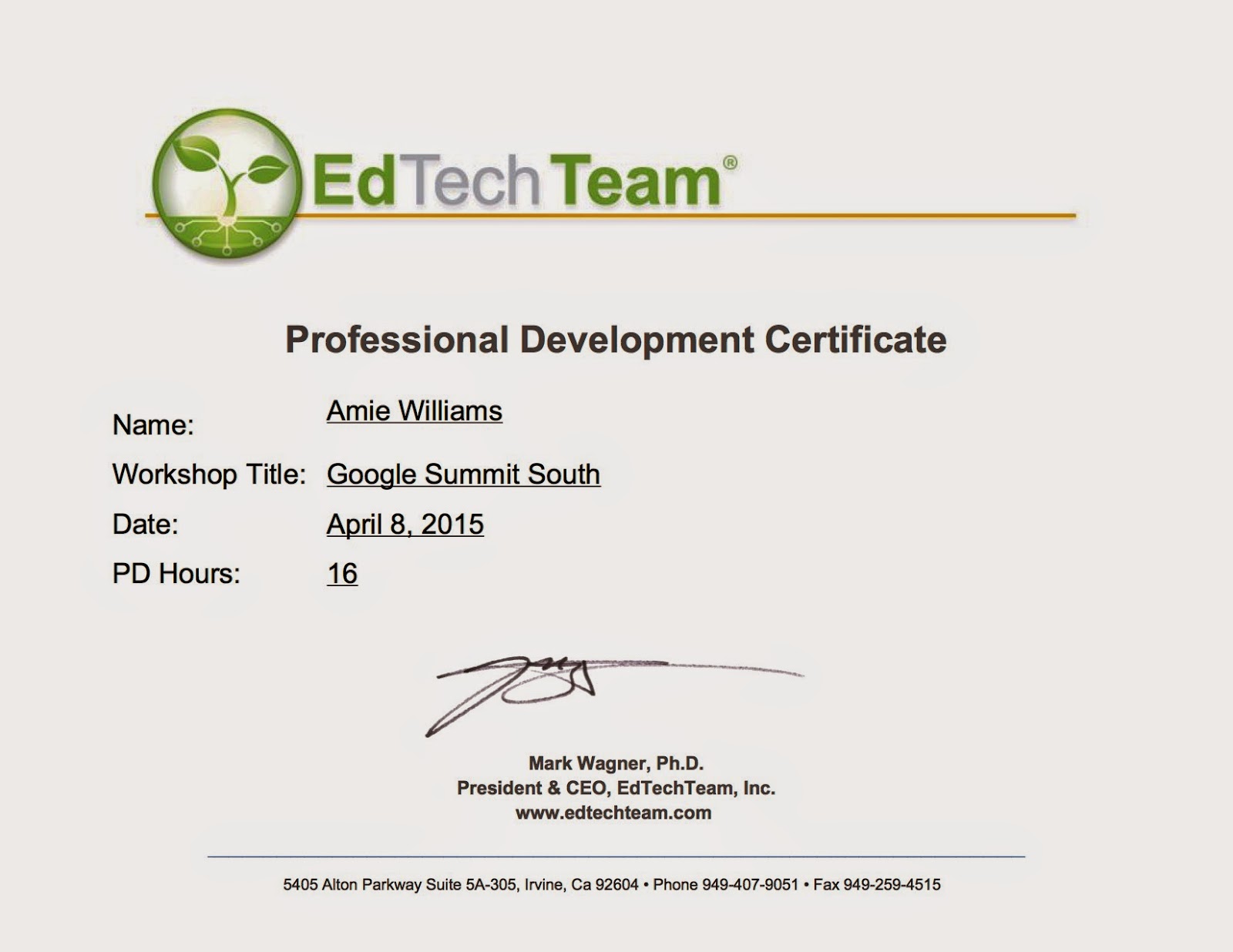
Google Summit South was held in Christchurch, where five of us GisInt teachers attended workshops at Burnside High over the course of April 8th and 9th, 2015. I've wanted to attend Google Summit for a few years now but had no idea of the impact it would have on my pedagogy, future direction and personal viewpoints.
While I wasn't overwhelmed with the number of suggestions of new tools or apps etc at the conference, this wasn't because there weren't a large number there - more due to the fact that in our past year, as a team, the e-learning team have explored so many great tools already. With the advent of Google Apps for Education, the focus has become less on teching and more on teaching. This means that what we encountered at Google Summit was more a great meeting of the minds and exploration of tried and tested practices, policies and pedagogies that are vital in our current state of education. Like Chris Betcher said, we are not there to teach the nouns - it's not important that our students know how to use Google Slides, or PowerPoint, or iMovie... but rather that they are able to ascertain the best tool to enact the verbs - persuading, presenting, explaining etc. Powerful shifts in education and as such, powerful and deep learning planned for our students. Technology use can make the learning superficial..... technology integration means using technology as just tools for learning. Nevermind the 'ICT focus' or 'e-learning' going on in the room - it's just learning.
And upon my return from Google Summit South I feel like my learning has been profound. I've gathered a few new tools.... but more importantly, I'm looking at how to integrate them seamlessly into our learning environments so they are inconspicuous but powerfully supportive of what we do as educators... moving our students towards environments where there is ubiquity, agency and connectedness in order for students to not just become 'life-long learners' but to become what the world needs - innovators, designers and creators.
Thank you Google Summit South!
Thursday, 9 April 2015
Google Docs for Writing
Kate Bodger
Resources here
katebodger.blogspot.co.nz
Share 3 before me
or
Google 3 b4 Me
Personalising learning by allowing students to write about whatever they like so long as the genre is being fulfilled. It's not important for students to all be writing about the same thing.
eg just focus on 'time connectives'
Writing templates on our community of learners site.
Making lesson plans using new tools as supportive tools with GAFE.
Lesson plans around comments. Lesson plans around blogging. Lesson plans around reflection.
Pen pals in Canada.
Using QuadBlog
Sharing with Buddies, Kaizena, Share work, Blogs, Video conferencing.
Resources here
katebodger.blogspot.co.nz
Share 3 before me
or
Google 3 b4 Me
Personalising learning by allowing students to write about whatever they like so long as the genre is being fulfilled. It's not important for students to all be writing about the same thing.
eg just focus on 'time connectives'
Writing templates on our community of learners site.
Making lesson plans using new tools as supportive tools with GAFE.
Lesson plans around comments. Lesson plans around blogging. Lesson plans around reflection.
Pen pals in Canada.
Using QuadBlog
Sharing with Buddies, Kaizena, Share work, Blogs, Video conferencing.
Where to with Google Teacher Certification? - Kimberley Hall
bitly here
https://docs.google.com/presentation/d/19yyxXcFDTOuz42HGglTNrQK_eGU7AXS7gKnmfuJFgpI/edit#slide=id.p
GoogleEdu to look at Google Questions
then
Google Teacher Certification
Go to google Testing Centre here https://google.starttest.com/
https://www.google.co.nz/edu/training/get-certified/

https://docs.google.com/presentation/d/19yyxXcFDTOuz42HGglTNrQK_eGU7AXS7gKnmfuJFgpI/edit#slide=id.p
GoogleEdu to look at Google Questions
then
Google Teacher Certification
Go to google Testing Centre here https://google.starttest.com/
https://www.google.co.nz/edu/training/get-certified/

Did this last year - very cool to have that first stage in the process now, coming to this.
Keep a resume of training (Workshops at ICT Cluster, School Workshops, TechXpo)
Techie Breakie etc
then
Then create a video of yourself teaching etc.
Jim Sill will tell you that you should be in the video at some point.
Women there is a real niche at the moment for female Google Education Trainers!
Must do Google Educator then on to Google Education Trainer.
Also must do the Google Educator exams every 18 months and log trainings with Google as well. Who did you train and where etc?
There are currently 6 trainers in the whole of New Zealand.
Kim sees this as a huge burgeoning market - get involved.
Google Certified Teacher - there are no prerequisites. It does ask if you've done those other things but it's not aimed at trainers but is aimed at innovative educators.
Outstanding educators
Creative leaders
Ambassadors for change
Teacher Academies are all quite different. Sydney etc is more pedagogically driven and seen as leading (name is being changed to something different from Google Certified Teachers).
There should be a Sydney one again - be conscious of the time zone for application.
Google Teachers Academy
Says check again near the end of April.
Subscribe to:
Posts (Atom)