Showing posts with label #learningtalk. Show all posts

Tuesday, 31 May 2016

Where to next?

31st May 2016 - Mindlab Graduation Celebration

Winter will be here tomorrow so this is a good checkpoint to stop and reflect. I'm celebrating the fact that I'm not studying at the moment and that I've thus had more time with my class and to concentrate on the kids' learning.  I'm really enjoying the work I'm doing with my focus group kids at the moment, particularly in maths, as the kids are responding so well.

It was exciting to finish MindLab, having developed a different perspective, and be moving into yet another phase of our great profession.  Learning and teaching is a challenging business to be in and I'm always growing as a result.  Learning alongside some great teachers over the past year has given me different experiences and I feel grateful for all my learning.


Looking back on times like these I wonder where I'd like to head next.

I particularly enjoyed studying and stretching myself into new learning territory.  I'm still interested in taking on a TeachNZ study award to try to go further with my learning.  I'm really interested in Leadership and in Change Initiatives in particular.  I had some interesting conversations with my ex-Principal, Nik House last week, when I visited him, and would love to continue to learn from him and his experiences.  He had a lot of important information to share and I would be interested in how I could best utilise this knowledge over the course of our change toward modern learning environments at GisInt in the future.  Collaborative teaching could be a great move for many of us.... AND will need significant scaffolding, support and inquiry learning processes to be in place in order for us to be successful.

He mentioned Michael Fullan, who writes on change leadership, so that will be an interesting next step.


Thursday, 10 March 2016

Math and Learner Agency

Daily at the moment I am having these amazing math sessions with our learners.

Why is it amazing?
The kids are engaged, stretching themselves, seeking help and expressing their enthusiasm through their voices and faces.  As they are enthusiastic and stretching themselves, we're able to see how they're learning, how they're challenging themselves and to have important learning conversations around how that's happening and the impact it's having on the whole class.


Why are they doing this?
I can only offer an opinion on this one but I feel like they're doing it because many of them have already come with a great foundation.  On top of this though - we're providing explicit opportunities to learn, we've built on this learning from their assessments (IKAN) and are showing the application to real life and thus, demonstrating its relevance.

In fact, two of our boys stated that when they could see the question (context), they could see WHY they were learning about (for example, how to convert between fractions, decimals and percentages; or how to divide by ten by moving the decimal place).  One of them threw up his hands in horror at the idea of working with fractions or percentages, but when applied to a context he knew (buying and selling Speedway Stock cars) he intuitively knew an answer.

Following explicit opportunities to learn, and links to relevant real life contexts, we are also talking a lot about the process.  We have discussed what's important in math.  We've talked about how sometimes we feel nervous, decide we can't do it before we start, read a problem and read it wrong and so misinterpret it or make an error and decide that that x instead of tick means we can stop the learning there, instead of returning to the problem and reworking it.  So we are developing a culture of accountability, expectation, challenge (I know to learn I need to be in the PIT and it will feel horrible but that is where I learn  - so I'm going to choose a hard problem to challenge myself and if that's too easy then when I'm finished I'm going to choose another one!

Why is this working?
Again, I can only offer an opinion, but I'd like to put this back to the kids to answer sometime in the future.  Perhaps it is because our feeling successful is not just dependent on our right or wrong answer, but is in fact partly determined by our willingness to build our learning habits and as such, our agentic practices.  Also, we are building our knowledge slowly through games, activities, problem solving etc, so we are having many opportunities to practice our learning habits and our new knowledge.

It's exciting seeing our nervous learners making progress and being willing to share their challenges and their progress.  Smiles and lightbulbs all round!

Tuesday, 8 March 2016

Inquiry Reflection Update

As part of my learning around Learner Agency I've been looking at ways to help the kids to develop their ability to know where they're at, self-assess and how to move forward from here. On reflection, one thing I was confronted with quite strongly was that I was not providing enough formative assessment opportunities for our learners, so they were quite negative about assessment processes.  They often walked away from a test feeling anxious and that they had not been prepared well, even when I felt I had prepared them.

I've been working on finding short, sharp modes of assessment that enable the kids to have checkpoints in their learning.  One example of this is that following a couple of days of learning around a topic, I've begun the lesson with a little formative assessment where the learners pick the level they feel they can stretch to and complete the task, assessing as they go.


In working through the answers, I used our student name cards (a set that is laminated and put in a container by my front computer for ease of use) to select students for answers so most people had a turn even if it wasn't at their stage.

After a while I just went around the room asking kids in turn and the positive mood improved.  When Jasmyn nutted out a problem beyond the stage she was working and I congratulated her on "the stretch" she was visibly excited by her ability to move forward.

Following this, I worked with those kids who have set Fractions as their goal based on their IKAN assessment results


and we made links between fractions, decimals and percentages, celebrated how using intuition helped the boys to solve problems, discussed how our attitude to a challenging subject helps / hinders our learning and demonstrated how applying a context (fractions) to a real-life subject (% off the price of a Stock Car) helped Seth to grasp the relevance of fractions and be willing to have a go...... and was successful instantly.

A $50,000 stock car is 75% off - how much will you pay?

This was an awesome math session with Malakai, Seth, Daniel, Josiah and Tapa - lightbulb moments were going off everywhere! Loads of the boys were saying "I get it now!"
My heart is happy.


Wednesday, 8 April 2015

Kimberly Hall - Improve Reading and Writing with Google

Kimberly Hall

Presentation is here:
https://docs.google.com/a/gisint.school.nz/presentation/d/1liyFpDw2kaGPqxVoQ8EGKY1fGDe91o6az3lJ2llVN44/edit#slide=id.g4782119f0_20


Using a table to get planning happening quickly without the issues


Change names to Heading1

Then
Insert
Table of Contents

Could use this for dates and headings etc in a personal doc,
Then you can click on these in order to hyperlink quickly to this area.  Great for feeding back to students quickly.

Google channel - watch cool Google clips here


Every time the kids add a new piece of writing they can add it to the same doc and every time they write they give it a heading "Descriptive Writing task 08/04/15"
Click Heading 1
then it will take you straight to that piece of writing.


Using
'mention comments'

+your.name@helpeachother.com

"This idea is similar to yours - maybe you should collaborate"

Lots of tools I've used before:
Sharing
Commenting
Suggesting edits
Revision history
Draftback

Awesome to play back for students to see history though - encouraging recrafting :)


Could we use a doc and for example - use adjectives to describe (colour code) then that will help kids to see what an adjective is and how to use more of them in their writing etc.
Collecting highlights using Google Read and Write - takes highlights in a similar colour and puts them in a new document - this would be a cool way to attempt to get as many new adjectives as possible without doubling up etc.

Using Kaizena for feedback - does this help reach more students by allowing them to access feedback regardless of reading ability?
Also, providing personalised touch to feedback in order to prevent that relationship level from being lost?

Accessing the Kaizena blog here may give extra ideas
Rubric criteria on Kaizena - click here

Use Clearly or Readability to clear up webpages so they're not so cluttered.  Allows saving or printing without the clutter.

Loads of cool ideas - extensions etc.  Looking forward to seeing now how I can implement these in order to best present ways for people to maximise their use of these and find shifts in pedagogy through my presentation at Tairawhite TeachXpo - hopefully!

How to make the whole process convincing and attainable and interactive?
Lots of fun to be had!


Monday, 23 March 2015

Digital Learning Communities

I really wanted to call this post 'brain explosions' as I really feel as though what's in my head is overflowing tonight. I'm really learning this year. 

I'm sure I learn every year, but in my role as co-leader of e-learning as well as facilitator of learning in our classroom (with an e-learning emphasis) I've been thrown: 
* into the Pit
* onto the silly bridge
 * out of my comfort zone

However you want to put it - I'm a learner again in the true sense of the word and it's exciting to be undertaking this journey alongside my students.  We are redesigning learning; together, and as a team. Co-constructing, it seems.

 Today, Saunil Hagler (iseeteaching.com) from Cyclone came to Gisborne to work with us on the next step in our e-learning journey.  (The whole idea of e-learning journey is an interesting one really - as many of us feel that the technologies we're using are simply tools for learning - there is no e-learning anymore, just learning).  We defined, we critically analysed, we discussed, we theorized, we idealised, threw aspirations around and developed and refined plans.  It's an exciting journey.

By the end of the day I'd learned everything from how to fix my GMail problem to how to shut all tabs to the right on my busy browser, to how to create links to learning to autonomise learning for our students in a digital learning community.  Never, have I been part of such a huge paradigm shift in education that has taken place over such a short space of time.  True, my "e-learning journey" began last year, but the bulk of my shifts in practice and pedagogy have taken place in the few short weeks since the beginning of term one.  Seven weeks.  The critical thinking I'm engaging in, the designing I'm doing and the collaboration and reflection in effect throughout this process is phenomenal.  I've never been more excited about my role in our classroom, in education in general.
Daily, life is chaotic, blurry and overflowing with learning.  Daily, I have to mentally 'shut tabs' in my head that force my brain to work overtime.  Daily, I am invigorated by the learning that I am doing.  I'm so encouraged by that, because I know that in order to be enthusiastic about learning, my students need to see I'm enthusiastic in my role as facilitator of that learning.

Saunil was knowledgeable, a patient teacher and an engaging facilitator.  We began the skeleton of our learning community.  As a staff and for our students, this platform could open up learning to all of us.  How effective would that be in terms of shifts in our practices as both teachers and learners.  Giving the steering wheel back to our students means they will regain autonomy in their learning.  It's scary to let go of that wheel for some of us.... but I'm excited about the journey - where will our students' learning journeys take us? I can't wait!


Thursday, 19 March 2015

Priority Learners

So my main focus this year is on engagement in the classroom.
To be perfectly honest I don't feel that engaging at the moment.  Our classroom feels more like a warzone some days with the behaviours we're coping with and I'm not sure how we're going to remedy it.

However, my main focus is on engagement, so my learning philosophy screams at me that if kids are engaged, they will be focused and the learning will be happening.

Priority learners are always at the forefront of this engagement debate, because engagement doesn't happen for all students in the same way.  Learners are diverse and as such, the strategies we employ to attempt to engage our students will need to be diverse too.

Technological tools have been suggested to improve engagement, but I think they probably only improve engagement if used in targeted ways.

This article suggests some of the ways these tools can be used for engagement.
One of the most difficult groups to engage are often our boys.

I've just finished watching this video about the impact on learning of culture - there is so much learning here!

I want to keep looking at Manaia Kalani and the practical methods of bringing te ao Maori, tikanga and reo into our classroom to improve the achievement of all our learners.

This video is about boys and writing and I think it's probably pretty relevant to my boys - it's hard to engage them all, but a lot of it is about getting to know them.
I'm hoping our blog can help us do that too.


Monday, 2 March 2015

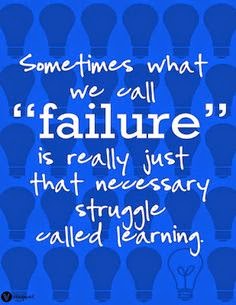
Failure


I could have given up today
Put my lesson down to one learning curve
of something not achieveable with a classroom
of thirty students.

I could have put my enthusiasm aside
cast down my determination to give my students
a voice
and a purpose in what we're doing this year.

Exclaimed that it was just too hard.
That it couldn't be done.
That I was doing my students an 
injustice 
by forcing them to 
struggle through
this difficult space
we have nicknamed 'The Pit'
that I was 'wasting their time' 
or
'letting them down'
But I persevered.
And I will persevere still.
Because when we spoke of the outcome
I saw light in their eyes
and I will chase that light
even though it's hard.
Because if they should fail
along this road of learning
they will simply learn that 
failure
is a necessary part of learning
nay, of life.
And failure is just one step in the long journey we call
learning
and life.

Amie, 2015

On reflection, speaking with a teacher later, who had visited last week and then took some of this learning back into her classroom, she shared with me her experience of starting out with Chromebooks.  About how she said she won't apologise; for noise, for frustration, for it being a bit chaotic to start with.  That they would muddle through because they were learning.  We talked about resiliency.  About how easy it is to ensure there is so much scaffolding for our students that they can't 'fail'.  About how now, they have become so helpless that when they approach a computer and it won't work, they throw up their hands and exclaim, "It won't go!" before walking away.  About how she then asked - "What have you tried?"

What a great opportunity we're now giving our students. 
To struggle...
To try...
To fail...
To try again....
To persevere....
To succeed....
To see the relevance this has to life.
And I saw the light in her eyes too.

We are learning.  Together.  I can't think of a better space to be.